
TL;DR: An AI LeetCode tutor should teach the reasoning between the prompt and the final code. Use it to clarify constraints, compare patterns, test edge cases, and rehearse an explanation—not to paste an answer you cannot defend.
Practice coding answers you can explain
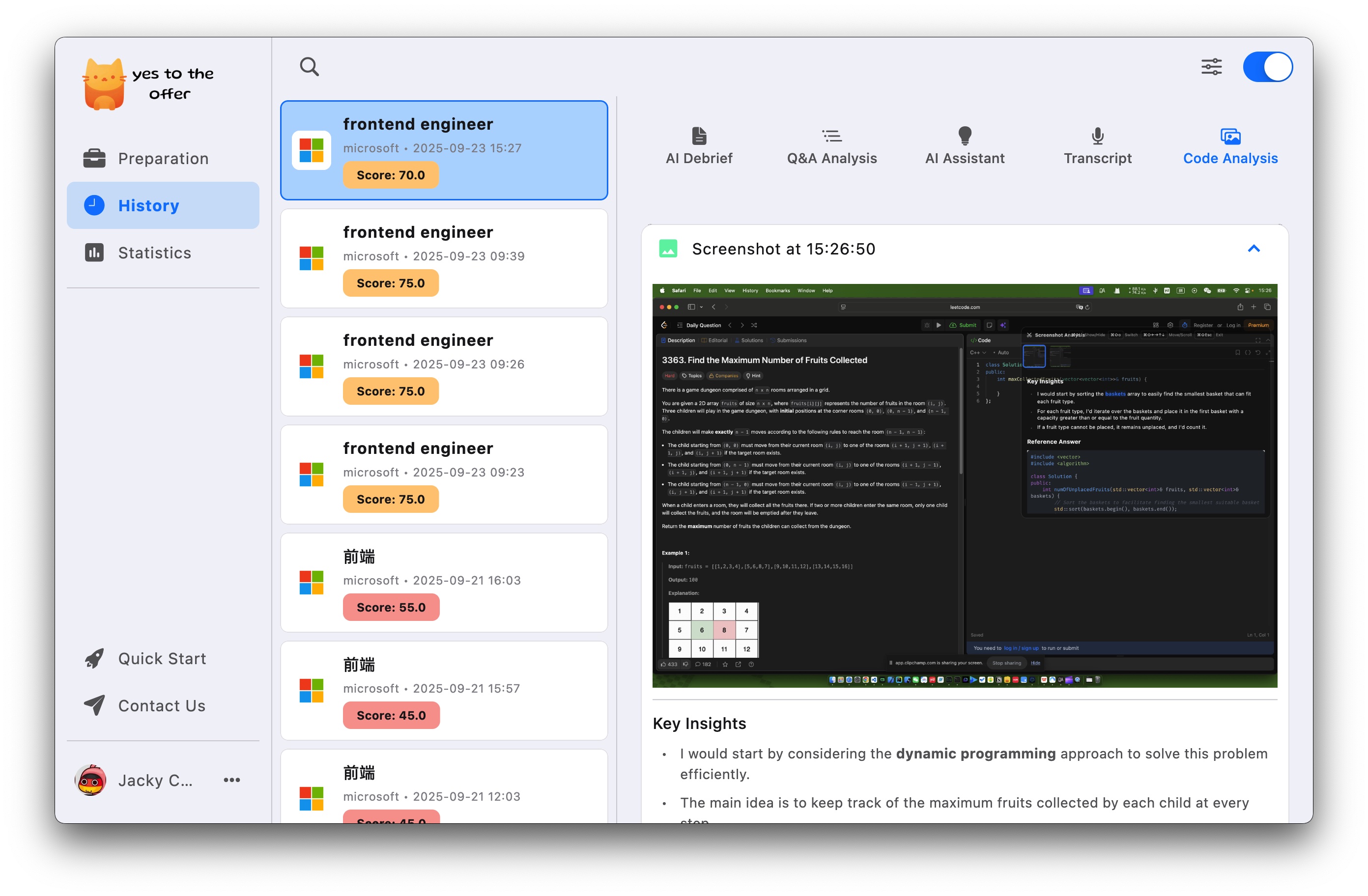
YesToTheOffer helps you organize coding prompts, reason through approaches, review code, and keep the target role and resume context together.
What is an AI LeetCode tutor?
An AI LeetCode tutor is a learning assistant that helps you reason through algorithm problems step by step, from interpreting the prompt to explaining complexity. The useful distinction is tutoring versus answer generation: a tutor asks what you know, exposes the next decision, and verifies your reasoning.

How should you use an AI tutor on a LeetCode problem?
Use the same five-pass workflow every time. Repetition turns isolated solutions into reusable interview patterns.
1. Restate the contract
Write the inputs, required output, constraints, and ambiguous cases in your own words. Ask the tutor to challenge your interpretation before discussing code.
2. Name the brute-force baseline
Describe the simplest correct approach and its time and space cost. This gives you a correctness anchor and makes the optimization meaningful.
3. Choose a pattern from evidence
Connect the constraints to a pattern such as two pointers, sliding window, binary search, a heap, graph traversal, or dynamic programming. Ask why the pattern fits and what signal would rule it out.
4. Dry-run before coding
Trace one normal case and one edge case. Record how indexes, state, or the data structure changes. Only then write code in the language you plan to use in interviews.
5. Explain and verify
State the invariant, complexity, and failure cases aloud. Ask the tutor for counterexamples and a follow-up constraint, then revise without replacing your entire solution.
AI LeetCode tutor vs. solution generator
| Dimension | Tutor workflow | Answer-generator workflow |
|---|---|---|
| Goal | Build transferable reasoning | Produce working code quickly |
| Interaction | Hints, questions, counterexamples | Complete solution and explanation |
| Interview readiness | You can defend each decision | You may recognize code but fail follow-ups |
| Best use | Practice, review, and mock explanation | Checking a solution after your own attempt |
A practical prompt sequence
Start with: ‘Do not give me code. Ask me three questions that reveal the constraints.’ Continue with: ‘Give me one hint toward the pattern,’ ‘Find a counterexample to my invariant,’ and ‘Act as the interviewer and ask a follow-up.’ This keeps you in the reasoning loop.
Common mistakes to avoid
- Requesting the full solution before making an attempt.
- Memorizing syntax without stating the invariant.
- Ignoring complexity until after coding.
- Testing only the sample input.
- Practicing silently instead of explaining tradeoffs aloud.
Responsible use
During a real assessment, follow the employer’s and platform’s rules. For permitted interview support, keep the output as concise notes and explain the reasoning in your own words. For a broader workflow, read the coding interview assistant guide and how an AI coding interview assistant works.
If you want a finite problem set for this workflow, use the Blind 75 study plan to sequence patterns, spaced review, and explanation practice.
FAQ
Can AI teach me LeetCode?
Yes. AI can guide problem interpretation, pattern selection, dry runs, complexity analysis, and follow-up practice. Learning improves when it gives hints before complete solutions.
Should I use an AI LeetCode tutor during an interview?
Only when the employer and interview platform allow it. Otherwise, use it before the interview for practice and afterward for review.
How is an AI tutor different from a coding solution generator?
A tutor keeps you making the decisions through questions, hints, and counterexamples. A generator mainly optimizes for producing finished code.
What should I ask after solving a problem?
Ask for counterexamples, an alternative approach, a stricter constraint, and interviewer-style follow-ups about complexity, invariants, and tradeoffs.
Can an AI tutor help with multiple programming languages?
Yes, but practice in the language you will use during interviews so syntax, standard libraries, and debugging habits become automatic.
Practice coding answers you can explain
YesToTheOffer helps you organize coding prompts, reason through approaches, review code, and keep the target role and resume context together.