
TL;DR: Blind 75 is a curated set of coding interview problems best used to learn reusable patterns, not to memorize solutions. Diagnose gaps, solve deliberately, explain tradeoffs aloud, and revisit problems on a spaced schedule.
Blind 75: A Practical Coding Interview Study Plan
Use the Blind 75 coding problems as a focused interview study plan, with pattern priorities, a six-week schedule, review rules, and answer practice.
Try YesToTheOfferWhat should you understand before preparing?
The list covers high-value patterns such as arrays and hashing, two pointers, sliding windows, stacks, binary search, linked lists, trees, tries, heaps, backtracking, graphs, intervals, greedy methods, dynamic programming, and bit manipulation. The exact order matters less than learning to recognize why a pattern fits.
Confirm the interview format and evaluation criteria first. Build a compact evidence bank from your resume, the job description, projects, decisions, mistakes, and measurable outcomes. Practice aloud, invite follow-up questions, and refine weak transitions.
For a repeatable workflow, combine the AI interview copilot guide, resume-grounded answer preparation, and post-interview review process.
Which questions should you practice?
- Explain the time and space complexity of a hash-map solution.
- Compare a sliding window with a two-pointer approach.
- Traverse a tree iteratively and recursively.
- Detect a graph cycle and justify the data structure.
- Turn a brute-force dynamic program into a reusable recurrence.
Use three passes. On the first pass, learn the pattern with notes. On the second, solve without notes and narrate decisions. On the third, mix categories so the problem no longer announces its pattern. Track date, hint level, complexity, bugs, and the next review date. A problem is not mastered until you can explain constraints, choose an approach, code it, test edge cases, and improve it under follow-up pressure.
Do not memorize scripts, invent metrics, or force one story onto every question. Ask for clarification when a prompt is ambiguous, distinguish facts from assumptions, and explain what you would verify when you do not know.
How should you structure a strong answer?
Start with a direct conclusion, add only the context needed, explain your reasoning or action, state the result, and close with what the example proves for this role. Technical prompts also benefit from explicit assumptions, edge cases, and a validation plan.
Use three passes. On the first pass, learn the pattern with notes. On the second, solve without notes and narrate decisions. On the third, mix categories so the problem no longer announces its pattern. Track date, hint level, complexity, bugs, and the next review date. A problem is not mastered until you can explain constraints, choose an approach, code it, test edge cases, and improve it under follow-up pressure.
Confirm the interview format and evaluation criteria first. Build a compact evidence bank from your resume, the job description, projects, decisions, mistakes, and measurable outcomes. Practice aloud, invite follow-up questions, and refine weak transitions.
What does a focused preparation plan look like?
| Answer part | Show | Avoid |
|---|---|---|
| Opening | Direct conclusion and scope | A long preamble |
| Evidence | A specific example or decision | Unsupported claims |
| Reasoning | Assumptions and tradeoffs | A memorized script |
| Review | One concrete improvement | Generic self-criticism |
- Confirm the interview format and evaluation criteria first. Build a compact evidence bank from your resume, the job description, projects, decisions, mistakes, and measurable outcomes. Practice aloud, invite follow-up questions, and refine weak transitions.
- Use three passes. On the first pass, learn the pattern with notes. On the second, solve without notes and narrate decisions. On the third, mix categories so the problem no longer announces its pattern. Track date, hint level, complexity, bugs, and the next review date. A problem is not mastered until you can explain constraints, choose an approach, code it, test edge cases, and improve it under follow-up pressure.
- Start with a direct conclusion, add only the context needed, explain your reasoning or action, state the result, and close with what the example proves for this role. Technical prompts also benefit from explicit assumptions, edge cases, and a validation plan.
- Do not memorize scripts, invent metrics, or force one story onto every question. Ask for clarification when a prompt is ambiguous, distinguish facts from assumptions, and explain what you would verify when you do not know.
How can AI support responsible interview preparation?
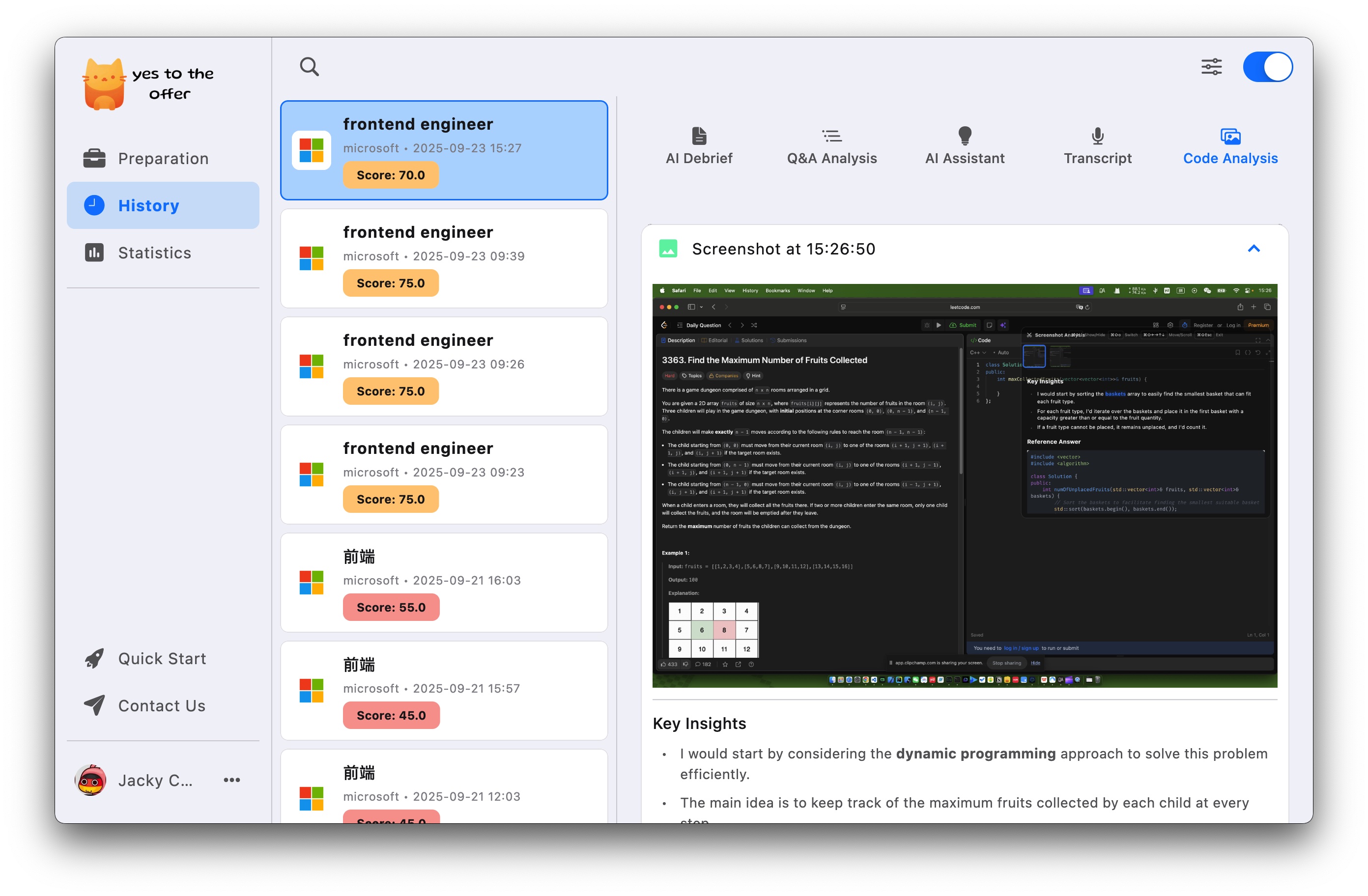
AI is most useful when it organizes material you already understand. YesToTheOffer can ground preparation and real-time interview support in your resume, job description, and private context, assist with coding, and preserve a transcript for post-interview review. Always follow the employer’s interview and assessment rules.
For a repeatable workflow, combine the AI interview copilot guide, resume-grounded answer preparation, and post-interview review process.
Frequently asked questions
FAQ
What is the Blind 75 list?
Blind 75 is a curated set of coding interview problems best used to learn reusable patterns, not to memorize solutions. Diagnose gaps, solve deliberately, explain tradeoffs aloud, and revisit problems on a spaced schedule.
Is Blind 75 enough for coding interviews?
Confirm the interview format and evaluation criteria first. Build a compact evidence bank from your resume, the job description, projects, decisions, mistakes, and measurable outcomes. Practice aloud, invite follow-up questions, and refine weak transitions.
What order should I solve Blind 75 in?
Start with a direct conclusion, add only the context needed, explain your reasoning or action, state the result, and close with what the example proves for this role. Technical prompts also benefit from explicit assumptions, edge cases, and a validation plan.
How long does Blind 75 take?
Do not memorize scripts, invent metrics, or force one story onto every question. Ask for clarification when a prompt is ambiguous, distinguish facts from assumptions, and explain what you would verify when you do not know.
Should I memorize Blind 75 solutions?
AI is most useful when it organizes material you already understand. YesToTheOffer can ground preparation and real-time interview support in your resume, job description, and private context, assist with coding, and preserve a transcript for post-interview review. Always follow the employer’s interview and assessment rules.
Practice with evidence from your own experience
Start with a direct conclusion, add only the context needed, explain your reasoning or action, state the result, and close with what the example proves for this role. Technical prompts also benefit from explicit assumptions, edge cases, and a validation plan.
For a repeatable workflow, combine the AI interview copilot guide, resume-grounded answer preparation, and post-interview review process.
Practice with evidence from your own experience
Use the Blind 75 coding problems as a focused interview study plan, with pattern priorities, a six-week schedule, review rules, and answer practice.
Try YesToTheOffer