
An AI coding interview assistant is useful when it makes the problem easier to reason about. It is much less useful when it turns the interview into answer lookup.
That distinction matters. In a real coding interview, the interviewer is not only checking whether the final code runs. They are watching how you read a prompt, ask clarifying questions, choose a strategy, explain tradeoffs, and recover from mistakes.
The assistant should support that process, not hide it.
Use coding support as a reasoning aid
YesToTheOffer helps candidates parse prompts, compare approaches, review code, and connect technical answers to resume and role context.
Step 1: Capture the prompt
The first job is getting the problem into a form you can inspect.
In online interviews, prompts may appear in several places:
- A shared coding editor.
- A pasted message in chat.
- A screen-shared document.
- A verbal explanation from the interviewer.
- A follow-up requirement added mid-interview.
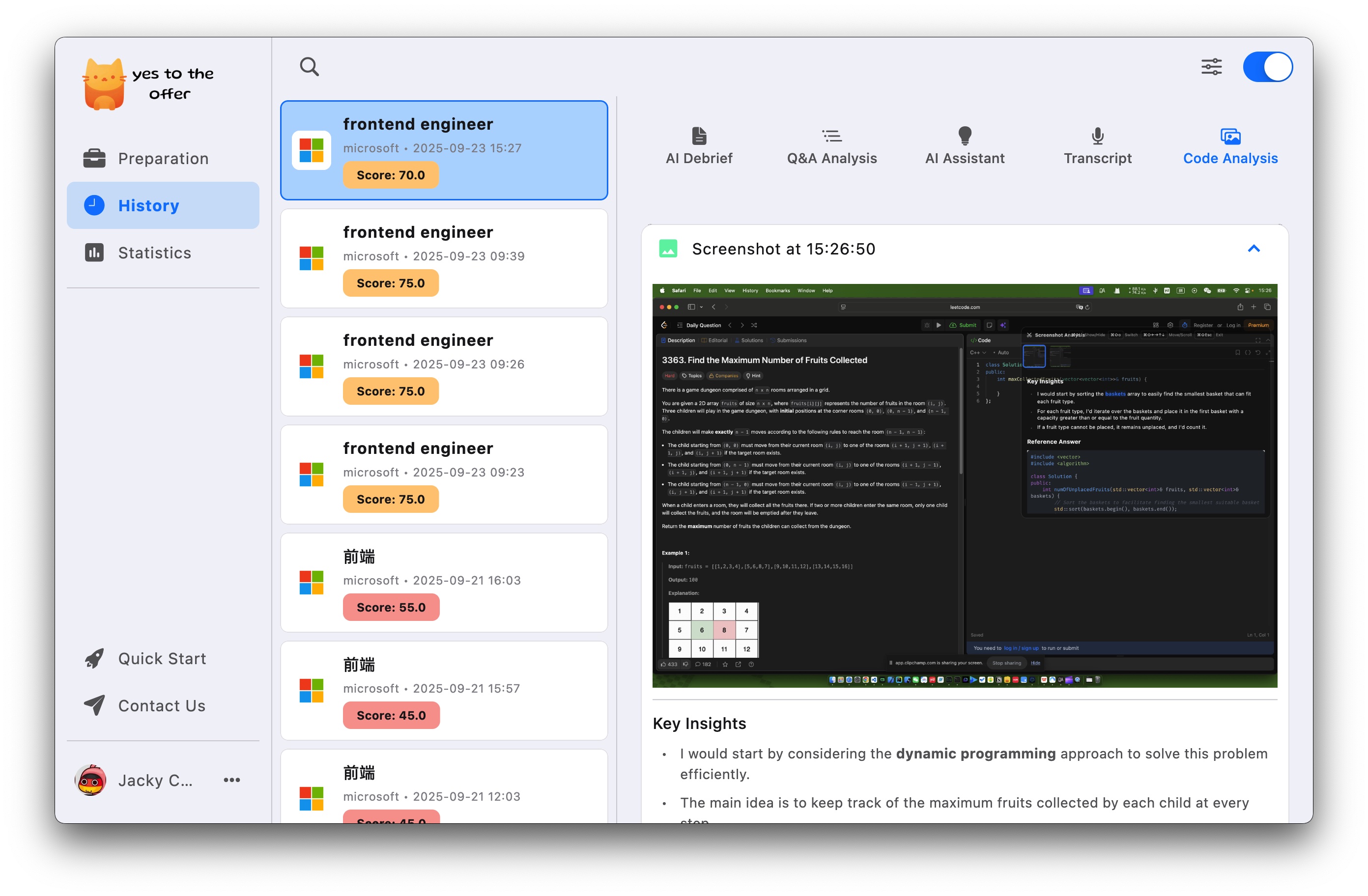
If the assistant supports transcription or screenshot analysis, it can help turn that scattered input into a cleaner prompt. This is especially helpful when the question has several constraints and examples.

Step 2: Separate requirements from examples
Many coding mistakes come from treating examples as the full requirement.
A good assistant should help you separate:
- Inputs.
- Outputs.
- Constraints.
- Edge cases.
- Expected time and space complexity.
- Ambiguous parts that need clarification.
For example, in a string-processing problem, the sample input may be lowercase only. The real requirement may still need decisions around empty strings, punctuation, Unicode, repeated characters, or memory limits.
Step 3: Compare approaches before writing code
Jumping straight into code is risky. A better interview flow is to outline at least two approaches:
| Approach | What to explain |
|---|---|
| Brute force | Why it works, where it fails, and expected complexity |
| Improved approach | The data structure or observation that reduces cost |
| Final choice | Why it fits the constraints and interview time |
This helps the interviewer see your reasoning. It also gives you a safer path if you discover a bug later.
An AI coding interview assistant can help list candidate approaches, but you still need to choose and explain the one you understand.
Step 4: Keep complexity visible
Candidates often remember to code but forget to communicate complexity.
Before writing the final version, check:
- What is the time complexity?
- What is the space complexity?
- Which input size would break the naive approach?
- Is the helper data structure worth the memory?
- Is there a simpler solution that is good enough?
This is where the assistant can act like a checklist. It should not replace your explanation, but it can keep you from skipping important details.
Step 5: Review code like an interviewer would
After writing the solution, review it from the outside:
- Does it handle empty input?
- Does it handle one item?
- Does it handle duplicates?
- Are indexes off by one?
- Is mutation intentional?
- Are names clear enough to discuss?
- Does the code match the approach you described?
For a broader technical workflow, read the coding interview assistant guide.
Step 6: Explain tradeoffs out loud
Technical interviews are collaborative. The interviewer needs to know what you are thinking.
A useful assistant can suggest talking points:
- "I will start with the straightforward approach to confirm correctness."
- "The bottleneck is repeated lookup, so a hash map helps."
- "This uses more memory, but it keeps the runtime linear."
- "If the input is sorted, we can simplify this."
- "If updates are frequent, I would choose a different structure."
These are not scripts. They are prompts to help you speak in a structured way.
Where YesToTheOffer fits
YesToTheOffer supports coding interviews as part of a broader desktop interview workflow. It combines real-time transcription, coding prompt support, screenshot analysis, resume and job context, private knowledge, and interview review.
That matters because coding interviews are rarely isolated. A technical question can turn into a system design follow-up. A hiring manager may ask how your past project relates to the code. A behavioral question may test how you debugged a production issue.
For live interview context, read the real-time interview assistant guide.
| Feature | YesToTheOffer | Practice-only workflow |
|---|---|---|
| Prompt handling | Uses transcription and screen context to help understand the live prompt. | Usually starts from a static practice question. |
| Approach planning | Helps compare brute-force, optimized, and tradeoff-aware approaches. | Often focuses on the final answer explanation. |
| Code review | Supports code analysis, edge cases, and communication points. | May review practice code outside the live interview flow. |
| Interview review | Keeps history so weak technical explanations can be improved. | May not preserve the actual interview context. |
Responsible use
Use a coding interview assistant within the rules of the interview and platform. The safest long-term approach is to practice deeply, use support to stay organized, and review each interview afterward.
FAQ
What does an AI coding interview assistant do?
It helps candidates understand coding prompts, identify constraints, compare solution approaches, reason about complexity, review code, and prepare clearer explanations.
Does it write the whole solution for you?
That is the wrong way to use it. The useful workflow is prompt understanding, structured reasoning, edge-case review, and communication support.
Can it help with system design?
Some assistants can help with system design by organizing requirements, components, tradeoffs, bottlenecks, and follow-up questions.
Should I still practice coding?
Yes. The assistant is most useful when you already understand the fundamentals and need help staying organized during a real interview.
Practice the reasoning, not just the answer
Use YesToTheOffer to prepare coding context, follow prompts, structure solutions, and review technical interview performance.