
TL;DR: This guide prepares you for snowflake interview questions with a practical framework, realistic examples, a comparison table, follow-up prompts, and an evidence-based practice plan.
Snowflake Interview Questions and Answers
This guide prepares you for snowflake interview questions with a practical framework, realistic examples, a comparison table, follow-up prompts, and an evidence-based practice plan.

What is the direct answer?
Start with a concise answer, explain the criteria behind it, and support it with a specific example. Strong responses make the candidate’s own decisions visible, acknowledge constraints, and close with a result or lesson. The core focus is architecture, virtual warehouses, data loading, performance, security, and practical tradeoffs.
What do interviewers evaluate?
Interviewers are not only checking vocabulary. They want to see how you understand the problem, choose among tradeoffs, communicate with other people, and verify the outcome. Read the job description and map every major responsibility to one real example before practicing.
Which questions should you practice?
- How does Snowflake separate storage and compute?
- What is a virtual warehouse and how do you size it?
- How do micro-partitions support pruning?
- When would you use zero-copy cloning?
- How would you diagnose a slow Snowflake query?
- What follow-up reveals the candidate’s reasoning?
- Which assumptions should be clarified?
- How do you distinguish team output from personal contribution?
- What evidence would change the decision?
- What lesson would you apply next time?
How should you structure a strong answer?
For each question, prepare a 30-second direct answer and a two-minute version. The longer version should add context, your individual action, alternatives you considered, and what changed. If a question is hypothetical, state your assumptions before proposing a sequence of actions.
A reliable structure has four parts: answer, criteria, evidence, reflection. Give the conclusion first. Then name the two or three factors that guided you. Describe what you personally did, without claiming the team’s work as your own. Finish with the result, what you learned, and what you would improve next time.
| Answer element | Include | Avoid |
|---|---|---|
| Direct answer | Start with a concise answer, explain the criteria behind it, and support it with a specific example. Strong responses make the candidate’s own decisions visible, acknowledge constraints, and close with a result or lesson. | Avoid vague claims, invented metrics, memorized definitions without application, criticism of former colleagues, and answers that hide your personal contribution. Do not force one success story into every prompt. When you lack direct experience, say so and explain how you would learn, test assumptions, and reduce risk. |
| Evidence | Interviewers are not only checking vocabulary. They want to see how you understand the problem, choose among tradeoffs, communicate with other people, and verify the outcome. Read the job description and map every major responsibility to one real example before practicing. | Avoid vague claims, invented metrics, memorized definitions without application, criticism of former colleagues, and answers that hide your personal contribution. Do not force one success story into every prompt. When you lack direct experience, say so and explain how you would learn, test assumptions, and reduce risk. |
| Reflection | A reliable structure has four parts: answer, criteria, evidence, reflection. Give the conclusion first. Then name the two or three factors that guided you. Describe what you personally did, without claiming the team’s work as your own. Finish with the result, what you learned, and what you would improve next time. | Avoid vague claims, invented metrics, memorized definitions without application, criticism of former colleagues, and answers that hide your personal contribution. Do not force one success story into every prompt. When you lack direct experience, say so and explain how you would learn, test assumptions, and reduce risk. |
How can you prepare step by step?
Build an evidence bank from your resume, job description, projects, and performance notes. Group stories by challenge rather than memorizing one script per question. Practice aloud, record the answer, remove filler, and ask a follow-up that tests a missing detail. Repeat until the opening sentence is clear but still sounds natural.
For each question, prepare a 30-second direct answer and a two-minute version. The longer version should add context, your individual action, alternatives you considered, and what changed. If a question is hypothetical, state your assumptions before proposing a sequence of actions.
Continue with: AI tools for data analyst interviews, terraform-interview-questions, system-design-interview-questions.
Which mistakes should you avoid?
Avoid vague claims, invented metrics, memorized definitions without application, criticism of former colleagues, and answers that hide your personal contribution. Do not force one success story into every prompt. When you lack direct experience, say so and explain how you would learn, test assumptions, and reduce risk.
A reliable structure has four parts: answer, criteria, evidence, reflection. Give the conclusion first. Then name the two or three factors that guided you. Describe what you personally did, without claiming the team’s work as your own. Finish with the result, what you learned, and what you would improve next time.
Frequently asked questions
FAQ
How does Snowflake separate storage and compute?
A reliable structure has four parts: answer, criteria, evidence, reflection. Give the conclusion first. Then name the two or three factors that guided you. Describe what you personally did, without claiming the team’s work as your own. Finish with the result, what you learned, and what you would improve next time.
What is a virtual warehouse and how do you size it?
Interviewers are not only checking vocabulary. They want to see how you understand the problem, choose among tradeoffs, communicate with other people, and verify the outcome. Read the job description and map every major responsibility to one real example before practicing.
How do micro-partitions support pruning?
Build an evidence bank from your resume, job description, projects, and performance notes. Group stories by challenge rather than memorizing one script per question. Practice aloud, record the answer, remove filler, and ask a follow-up that tests a missing detail. Repeat until the opening sentence is clear but still sounds natural.
When would you use zero-copy cloning?
For each question, prepare a 30-second direct answer and a two-minute version. The longer version should add context, your individual action, alternatives you considered, and what changed. If a question is hypothetical, state your assumptions before proposing a sequence of actions.
How would you diagnose a slow Snowflake query?
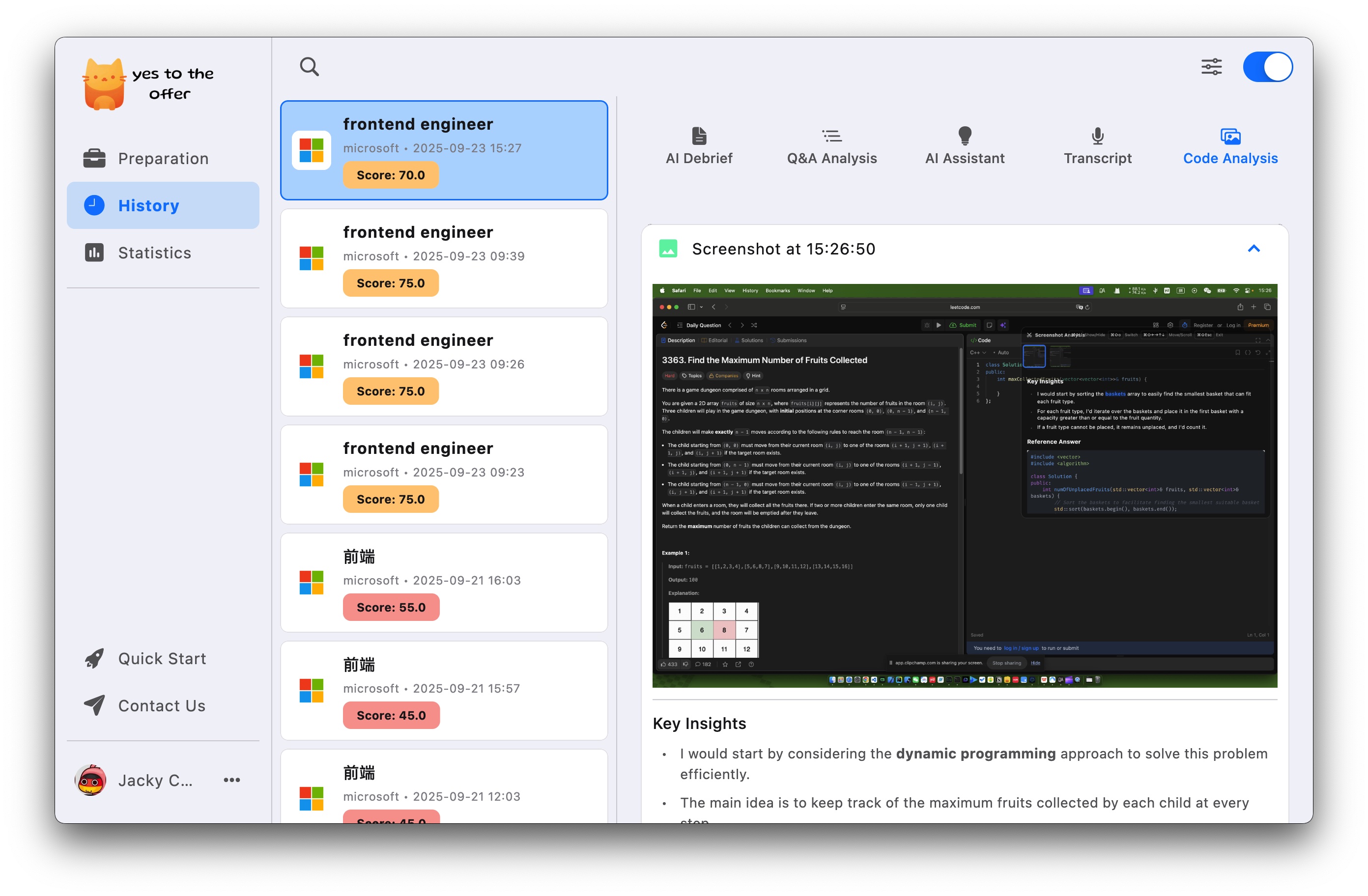
YesToTheOffer can organize practice questions around your resume and private context, provide real-time interview support where employer rules allow it, assist with coding discussions, and help review a transcript afterward. Use it to retrieve evidence and improve clarity, never to invent experience or bypass an assessment.
Practice with evidence, not a script
YesToTheOffer can organize practice questions around your resume and private context, provide real-time interview support where employer rules allow it, assist with coding discussions, and help review a transcript afterward. Use it to retrieve evidence and improve clarity, never to invent experience or bypass an assessment.
Build an evidence bank from your resume, job description, projects, and performance notes. Group stories by challenge rather than memorizing one script per question. Practice aloud, record the answer, remove filler, and ask a follow-up that tests a missing detail. Repeat until the opening sentence is clear but still sounds natural.
Practice with evidence, not a script
YesToTheOffer can organize practice questions around your resume and private context, provide real-time interview support where employer rules allow it, assist with coding discussions, and help review a transcript afterward. Use it to retrieve evidence and improve clarity, never to invent experience or bypass an assessment.