
STAR is a useful interview framework, but it has a reputation problem. Too many answers sound like they were assembled from a template:
"In my previous role, I faced a challenge. I took action. The result was positive."
That is technically STAR. It is also forgettable.
A good STAR interview answer generator should do something more specific: help you turn real work into a clear story that fits the question, the role, and the level of the interview.
Turn real projects into stronger behavioral answers
YesToTheOffer helps candidates organize project stories, resume details, and private notes into interview-ready answer context.
What STAR is good for
STAR stands for:
- Situation: what was happening.
- Task: what you were responsible for.
- Action: what you did.
- Result: what changed because of it.
The framework works because behavioral interviews are not asking for personality traits in isolation. They are asking for evidence.
If an interviewer asks, "Tell me about a time you handled ambiguity," a weak answer says, "I am comfortable with ambiguity." A stronger answer shows the moment, the decision, the constraints, and the outcome.
Why generic STAR generators fail
Most weak STAR answers have the same problems:
- The situation is too broad.
- The task does not show ownership.
- The action is a list of team activities, not your decisions.
- The result has no clear outcome.
- The story does not match the company or role.
This is why resume context matters. A behavioral answer should come from your actual projects, incidents, users, stakeholders, metrics, and tradeoffs.

A better workflow for generating STAR answers
Start by collecting raw material. Do not write polished stories first.
Useful inputs include:
- Projects from your resume.
- Incidents where something went wrong.
- Examples of leadership without authority.
- Times you disagreed with a teammate or stakeholder.
- Product, engineering, or business decisions with tradeoffs.
- Metrics, before-and-after outcomes, or qualitative user feedback.
- Lessons you changed behavior around.
Then map each example to question types:
| Example type | Useful for |
|---|---|
| A production issue | ownership, pressure, communication, failure |
| A messy project handoff | ambiguity, collaboration, prioritization |
| A performance improvement | impact, technical depth, tradeoffs |
| A difficult stakeholder | influence, conflict, product judgment |
| A missed deadline | learning, accountability, planning |
Once the raw material exists, the generator can help shape it into a story without inventing the story.
Example: turning notes into STAR
Raw notes:
- Team had a slow dashboard used by account managers.
- Queries were expensive and pages took several seconds to load.
- PM wanted a quick UI refresh, but the real issue was data loading.
- I profiled the API, added caching for stable segments, and moved one aggregation offline.
- Load time dropped and support complaints went down.
Interview question:
"Tell me about a time you improved something that was not originally assigned to you."
STAR outline:
- Situation: account managers were losing time on a slow dashboard.
- Task: the official request was a UI refresh, but the performance issue was blocking daily work.
- Action: profiled the backend path, identified the expensive aggregation, proposed a smaller technical fix, and coordinated with PM on scope.
- Result: the dashboard became faster, account managers had fewer interruptions, and the team avoided spending time on a cosmetic fix first.
That answer is not flashy. It is useful because it shows judgment.
How YesToTheOffer fits
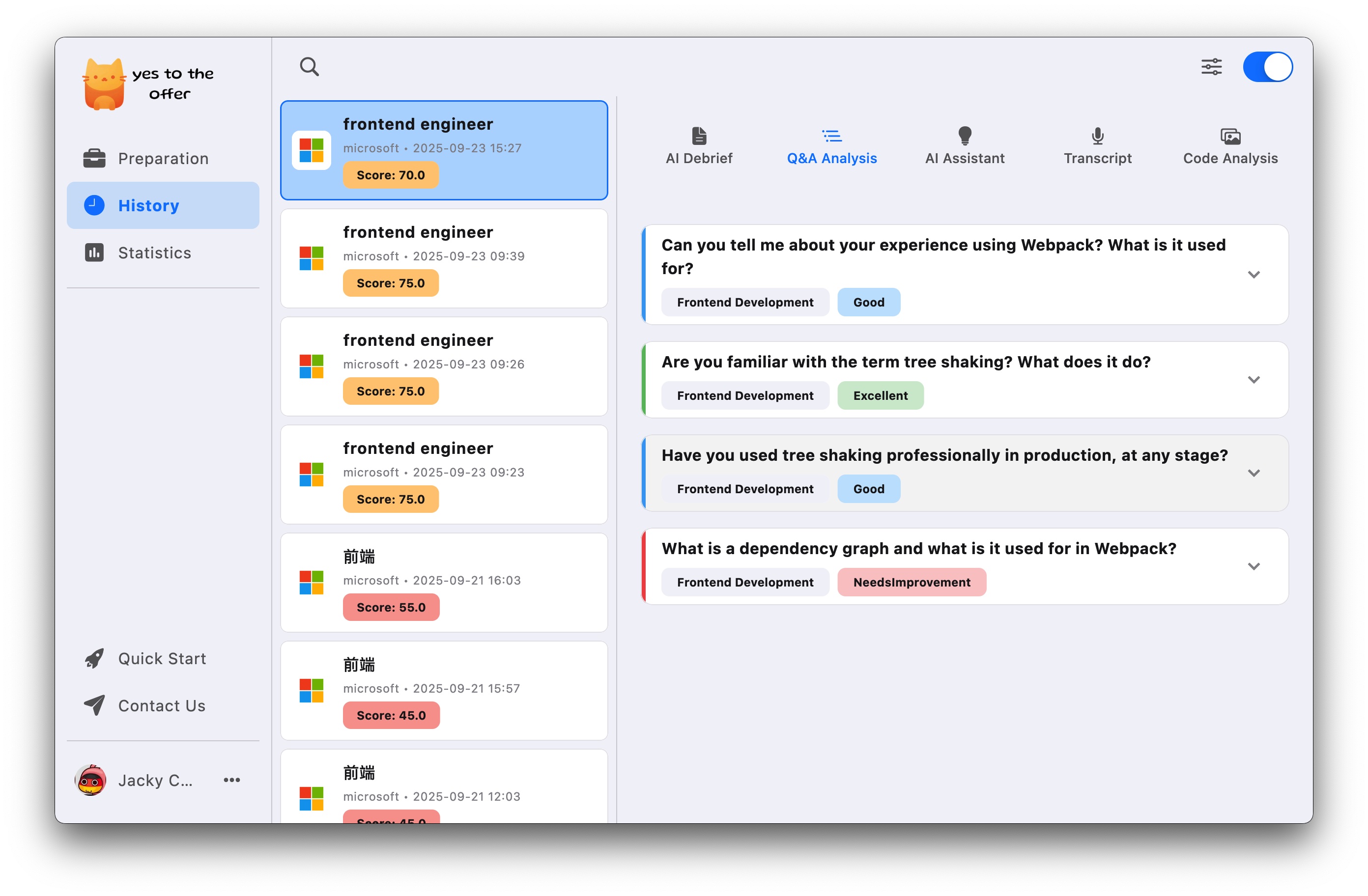
YesToTheOffer supports behavioral interview preparation by letting candidates keep resume details, project notes, STAR examples, and job context close to the interview workflow.
The product is especially helpful when a question needs a specific story fast. Instead of searching memory under pressure, you can prepare a private knowledge base of real examples before the call.
For the broader behavioral workflow, read the behavioral interview AI assistant guide. If you want the answer to adapt to a specific role, read the resume-based interview answer assistant guide.
How to avoid sounding scripted
Use the framework, but do not recite the framework.
Better behavioral answers usually have these traits:
- One clear story, not three examples at once.
- A specific constraint.
- A decision you personally influenced.
- A result that is honest and proportional.
- A short reflection on what you would repeat or change.
If the result was not a perfect success, say that. Interviewers often trust a measured answer more than a polished success story.
Responsible use
Do not use a STAR generator to manufacture experience. Use it to organize real experience. The goal is to make your answer easier to follow, not to turn every question into a rehearsed speech.
FAQ
What is a STAR interview answer generator?
A STAR interview answer generator helps structure behavioral interview answers around Situation, Task, Action, and Result using real experience from your resume or notes.
Will STAR answers sound scripted?
They can if the input is generic. Strong STAR answers come from specific projects, decisions, tradeoffs, metrics, and lessons.
Can I use it for leadership questions?
Yes. STAR works well for conflict, ownership, leadership, failure, ambiguity, and collaboration questions when the example is concrete.
Should every behavioral answer use STAR?
No. STAR is a useful structure, but some answers need a shorter direct response. Use the format when a story helps.
Build a private library of interview stories
Use YesToTheOffer to keep resume examples, project notes, STAR stories, and target-role context ready for behavioral interviews.