
TL;DR: Start with the interview format and the evidence you can honestly defend. Group practice by competency, answer aloud, and review the reasoning—not just the final wording.
How to Conduct a Panel Interview: Structured Guide
Learn how to conduct a panel interview with defined roles, consistent questions, independent scoring, useful follow-ups, and a fair debrief.
Try YesToTheOfferIn this guide
- What should you prepare first?
- Which questions should you practice?
- How should you structure strong answers?
- What should your preparation plan include?
- How can AI support a responsible workflow?
A strong panel uses a shared rubric, assigned roles, consistent core questions, and independent notes before discussion. Candidates can prepare by learning who will attend, addressing the whole panel, and keeping examples concise enough for follow-up questions.
What should you prepare first?
Before collecting more questions, confirm the interview stages, time limits, tools, and evaluation criteria. Build a short evidence bank from your real projects, decisions, mistakes, and results. This makes follow-up questions easier because the substance is already yours.
A useful baseline is three passes: first explain the concept without notes, then solve or answer under a realistic limit, and finally inspect the transcript or code. Keep a short error log with the prompt, the missed assumption, the correction, and one new test.
Which questions should you practice?
- What is a panel interview?
- How many interviewers should be on a panel?
- How should panelists divide roles?
- Should every candidate receive the same questions?
- How should a panel make its final decision?
Avoid memorizing scripts, inventing metrics, or treating every prompt as identical. Practice interruptions and follow-ups. If you do not know something, explain what you would verify and how you would proceed.
Do not stop after producing an acceptable answer. Ask yourself what the interviewer could challenge: a missing stakeholder, an untested edge case, a vague metric, or a tradeoff you did not acknowledge. The best practice questions create useful follow-ups rather than a pile of memorized responses.
How should you structure strong answers?
A reliable answer begins with a direct conclusion, then explains context, choices, action, and result. For technical prompts, state assumptions, compare alternatives, and test edge cases. For behavioral prompts, make your own contribution visible without erasing the team.
Use a compact opening of one or two sentences. Then earn depth with evidence. A behavioral example usually needs the situation, your responsibility, the action you personally took, the observable result, and a reflection. A technical example needs assumptions, a baseline solution, correctness checks, complexity or resource analysis, and alternatives.
When the prompt is ambiguous, ask a clarifying question that can change the solution. Avoid asking for information that does not affect your decision. If the interviewer supplies a constraint, repeat it briefly and show how it changes your approach.
What should your preparation plan include?
| In this guide | Show | Avoid |
|---|---|---|
| Opening | Direct answer and scope | Long autobiography |
| Evidence | Specific decision or example | Unsupported claims |
| Reasoning | Assumptions and tradeoffs | Jumping to an answer |
| Review | One concrete improvement | Generic self-criticism |
- Confirm format and evaluation areas
- Build six to eight evidence-backed examples
- Practice concise openings and deeper follow-ups
- Review weak claims and missing assumptions
- Prepare questions and a calm closing
Schedule practice across several sessions rather than one long cram. Alternate recall, live explanation, and review. For role questions, choose examples that cover different competencies. For coding questions, rotate implementation, debugging, testing, and explanation. The goal is flexible command of the material, not a fixed performance.
How can AI support a responsible workflow?
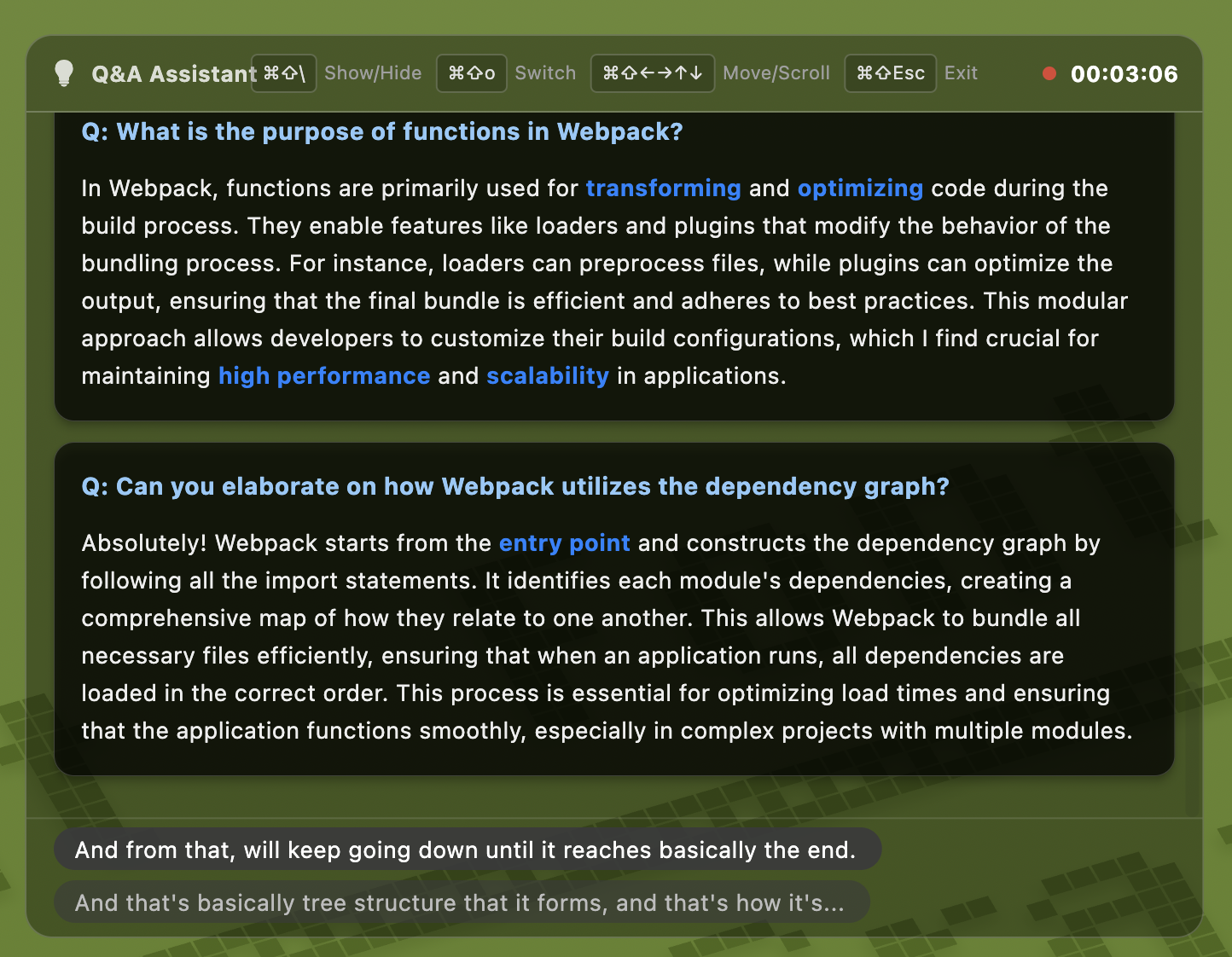
AI is most useful when it organizes material you already know. YesToTheOffer can ground preparation and real-time support in a resume, job description, and private context, assist with coding and answer structure, and preserve a transcript for post-interview review. Follow the employer's rules and never use support to misrepresent skills.
A responsible workflow has three phases. Before the interview, load accurate resume and job context, create questions, and rehearse. During an interview, use only support permitted by the employer and platform; keep the response grounded in your own knowledge. Afterward, inspect the transcript for omissions and build the next practice set.
Explore the coding interview assistant, behavioral interview support, and interview transcription and review according to the skill being tested. These links represent different preparation needs, not shortcuts around evaluation.
If several candidates are assessed together, the group interview questions guide explains turn-taking, collaborative exercises, respectful disagreement, and how to contribute without dominating.
Frequently asked questions
FAQ
What is a panel interview?
Give a direct answer, then connect it to a specific example, assumption, or test. End with the result and what you learned.
How many interviewers should be on a panel?
Use a real example and make your decision process visible. If evidence is missing, say what you would verify instead of inventing it.
How should panelists divide roles?
State the goal and constraints first. Compare alternatives, explain the tradeoff, and name a practical check for correctness.
Should every candidate receive the same questions?
Keep the opening concise, then be ready to expand when the interviewer asks why, what changed, or how you measured the result.
How should a panel make its final decision?
Practice aloud and review the transcript for unclear ownership, weak assumptions, and claims that your evidence does not support.
Practice with evidence from your own experience
Start with the interview format and the evidence you can honestly defend. Group practice by competency, answer aloud, and review the reasoning—not just the final wording.
Practice with evidence from your own experience
Use your resume, the job description, and private notes to prepare, get real-time structure support, and review the interview afterward.
Try YesToTheOfferThe keyword-plan source records US volume 1,600 and KD 20 for topic selection; those planning metrics are not claims about interview outcomes.
